
Lodestone: The Stone That Leads
Introduction
Another important stone we should discuss in the course of understanding electricity is Lodestone. It is a naturally magnetized piece of the mineral magnetite—heavy, black mineral rich in iron oxide that forms deep within the Earth. It would be surprising to learn that only a small amount of the magnetite on the Earth is found magnetized as lodestone.
While amber was amusing the ancients with its “magic” tricks of attracting chaff, lodestone was exhibiting a power that attracts iron without any friction. The attraction was constant, permanent, mysterious.
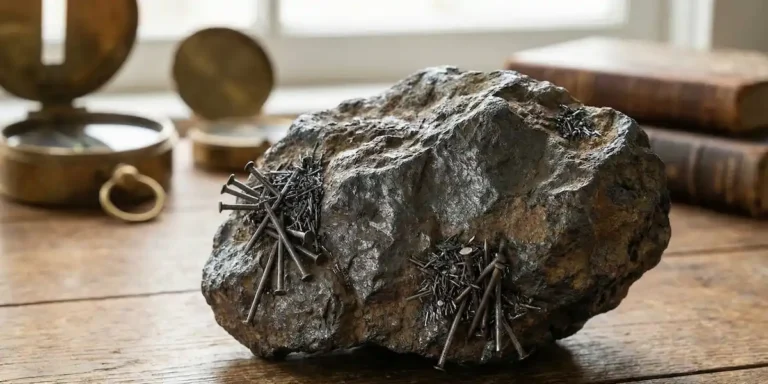
But lodestone held an even deeper secret. If you suspended it freely—floating it on water or hanging it from a thread—it would always orient itself in the same direction: pointing North and South. This directional property would eventually transform human civilization, enabling sailors to cross entire oceans and map the entire globe.
The name “lodestone” comes from the Old English words “lād” (direction) and “stān” (stone)—literally “direction stone” or “leading stone.” It perfectly captures what people observed: a stone that mysteriously points the way.
The Legend of Magnes
The Greeks called lodestone by several names. The most common was magnet or magnetic stone, derived from Magnesia, a region in Thessaly, Greece where lodestones were found. They also called it the “Heraclean stone” or “stone of Heraclea,” possibly referring to a location famous for these stones.
According to legend (a traditional story passed down through generations), a herdsman named Magnes was tending his flock when the iron tip of his staff and the iron nails in his boots stuck to a lodestone he stepped on. Whether this tale was exaggerated over centuries or based on a real event, it gave magnetism its name—another case of ancient myths preserving real discoveries.
Ancient Observations of Magnetism
The Western Records
Around 600 BCE—the same era when Thales observed amber—Greek thinkers also noticed lodestones. In fact, Thales applied his “soul theory” here too: lodestones must possess a soul that allows them to move iron without contact.
Empedocles (fl. 444–443 BCE) proposed a different explanation: “emanations.” Objects gave off invisible particles or emanations that flowed from the magnet to the iron, pulling it along.
Aristotle (384–322 BCE)—the dominant authority for centuries—proposed that there must be invisible air between the lodestone and iron, transmitting the force.
Lucretius (c. 60 BCE), in his poem De Rerum Natura, described magnetic repulsion and the ability of the magnet to support a chain of iron rings.
St. Augustine (426 CE) recorded seeing an iron ring suspended by a magnet, which in turn suspended others, forming a chain. He also witnessed iron moving on a silver plate guided by a magnet underneath.
China: The Earliest Practical Discovery
While Greeks were pondering the mystery, the Chinese were using it.
The earliest written Chinese reference to magnetism dates to around the 4th century BCE, when the philosopher Wang Xu noted: “The lodestone attracts iron.”
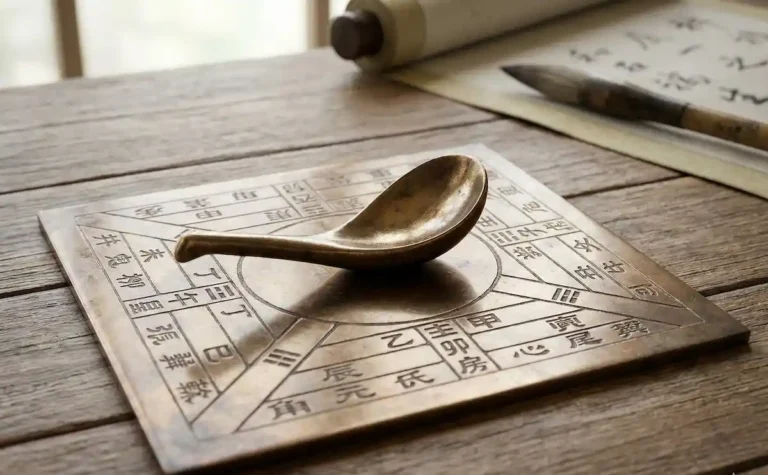
By the 1st century CE, Wang Chong, a Chinese author and philosopher, described personally observing what he called a south-pointing spoon—a piece of lodestone carved into a spoon shape that, when placed on a smooth surface, would come to rest pointing south. This was the first clear written documentation of lodestone’s directional property.
Initially, it wasn’t used for navigation, but for Feng Shui (geomancy)—to align houses and tombs in harmony with nature. But sometime around the 11th century CE, Chinese sailors made a crucial discovery: a magnetized needle could be used to navigate.
The Chinese Revolution: The Compass is Born
By the Song Dynasty (c. 1040 CE), they had refined this into the South-Pointing Fish—a piece of magnetized iron cut in the shape of a fish that floated in a bowl of water. This was the ancestor of the modern compass.
The Magnetic Needle
A Chinese scientist named Shen Kuo (1031-1095 CE), writing in his Dream Pool Essays (1088), gave us the most detailed early description of how magnetic needles worked.
He described how geomancers magnetized a needle by stroking it with lodestone, then suspended the needle from a single strand of silk with a bit of wax attached. When suspended this way, the needle would align north-south.
The Compass Spreads Westward
By the 12th century, the magnetic compass had spread from China to the Islamic world and Europe.
The first clear European mention of a compass came from Alexander Neckam, an English scholar who, around 1190 CE, wrote about sailors using magnetic compasses for navigation in his work De Utensilibus (On Instruments).
By the 13th century, Arab navigators were using compasses. By the 14th century, Scandinavian sailors had adopted them.
This spread wasn’t instantaneous, but it was steady. Within roughly 200 years, the Chinese invention had circled the globe and revolutionized navigation everywhere it reached.
The First Experimental Scientist: Petrus Peregrinus
For centuries, people used magnets without understanding them. Sailors thought the compass pointed North because of a giant “Magnetic Mountain” at the North Pole that ate ships’ nails!
The first man to treat magnets scientifically was a French soldier-engineer named Petrus Peregrinus (Peter the Pilgrim). In 1269, while besieging a city in Italy, he wrote the first serious scientific treatise on magnets: Epistola de Magnete (Letter on the Magnet).
He also described the construction of the first pivoted compass, a major leap forward from the floating needles used by earlier mariners.
Peregrinus discovered three crucial facts that we still use today:
Poles: He realized the magnetic force wasn’t all over the stone, but concentrated at two points. He (possibly) shaped a loadstone into a sphere (a “terrella”) and used needles to trace the magnetic lines, discovering that magnets have two distinct “poles.”
The Law of Attraction and Repulsion: He observed that North attracts South, but North repels North.
Indestructibility of Polarity: He found that if you break a magnet in half, you don’t get a separate North piece and South piece. You get two smaller, complete magnets.
Navigation Prior to the Compass
Before the magnetic compass was invented, sailors mostly relied on what they could see in the sky and on the horizon. They used coastlines, islands, and other landmarks, along with the positions of the Sun, Moon, and stars, to find their way.
In some regions, people also used clever local techniques—like checking mud from the seafloor, watching bird flight paths, or reading wind and wave patterns—to judge direction and location. On cloudy or foggy days, though, these methods often failed, and navigation became risky.
The magnetic compass changed everything. It allowed mariners to keep a steady heading even when the sky was overcast or no land was in sight. This made long-distance sea voyages much safer, boosted ocean trade, and helped launch the great era of global exploration often called the Age of Discovery.
The Compass and the New World
By the 13th and 14th centuries, the magnetic compass had become the mariner’s most vital tool. However, sailors believed the needle always pointed true North.
It was Christopher Columbus, during his 1492 voyage to the Americas, who famously observed that this was not true. He noticed that the needle deviated slightly from the Pole Star depending on his position in the ocean. This was the discovery of magnetic declination (or variation)—the realization that magnetic north and true north are not the same.
Ferdinand Magellan (1480–1521 CE), who organized the Spanish expedition (1519–1522) that achieved the first known circumnavigation of the Earth. The fact that the “world is round” was firmly established by Magellan’s circumnavigation. And this would have been impossible without the magnetic compass.
“If amber gave electricity its name, the lodestone gave the world its map.”
The Dipping Needle
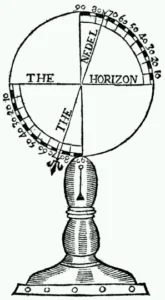
In 1576, an English compass maker named Robert Norman made a frustrating discovery. No matter how perfectly he balanced his needles, they always dipped downward after being magnetized.
Instead of fighting it, he built a special instrument to measure it. He invented the Dip Circle and published The Newe Attractive, proving that the magnetic force doesn’t just pull north, it pulls down toward the earth.
Conclusion
The lodestone transformed from a mythical rock into the most valuable tool in human history. By taming this mysterious force, humanity unlocked the ability to cross oceans and map the globe. Yet, as the 1500s came to a close, the compass was still a tool without a scientific theory; sailors knew how to use it, but no one knew why it pointed North.
This unanswered “why” set the perfect stage for William Gilbert, who would be the first to study magnetism systematically and turn mystery into science.
Experience It Yourself: Compass & Magnetic Field (DIY)
You can replicate the Chinese “South-Pointing Fish” and Peregrinus’s experiments with a simple setup.
Experiment 1: The Water Compass
What You Need:
-
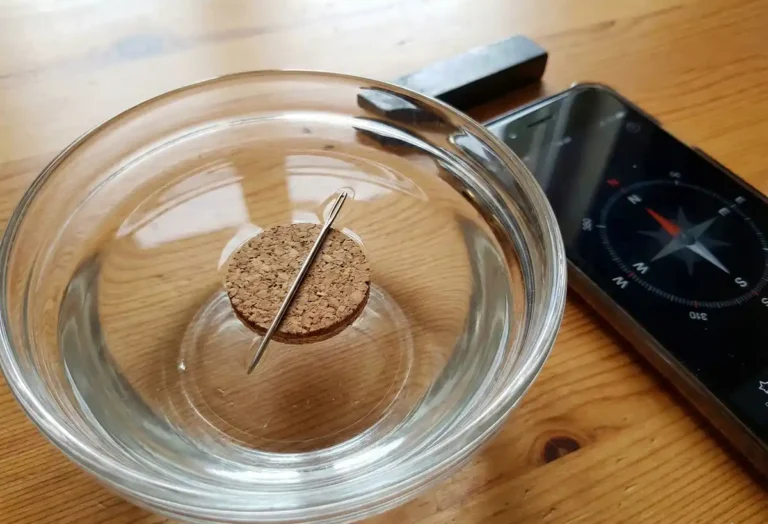
A sewing needle
-
A strong magnet (fridge magnet works, Neodymium magnet is better)
-
A small slice of cork or a leaf
-
A bowl of water
What To Do:
-
Magnetize the Needle: Stroke the needle with your magnet with South Pole 50 times. Important: stroke in one direction only (from the eye to the point), lifting the magnet between each stroke. Do not rub back and forth.
-
Float It: Carefully push the needle through the slice of cork (or rest it on a floating leaf).
-
Observe: Place it in the bowl of water. The needle will slowly spin and align itself North (the point)-South (the eye). Why?
-
Reverse Polarity: Now try to stroke the needle with North Pole. Place the needle back on the water. You will see the needle spin 180 degrees! The Point, which previously faced North, will now swing around to face South.
What You’re Experiencing: You have just created the navigational instrument that allowed humanity to explore the globe. The invisible magnetic field of the Earth is grabbing the electrons in your needle and pulling them into alignment.
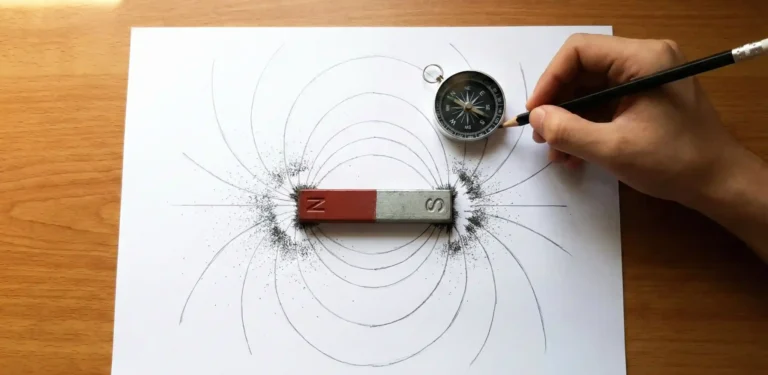
Experiment 2: The Magnetic Field Pattern
What You Need:
A sheet of white paper
A bar magnet (or any strong magnet)
A small compass (or the magnetized needle from Experiment 1)
A pencil
What To Do:
Place & Trace: Put the magnet in the center of the paper and trace its outline with your pencil so it doesn’t move.
The Scout: Place your small compass (or needle) near one corner of the magnet. Look at the direction the arrow points.
Mark the Path: Make two small dots on the paper: one at the tail of the arrow, and one at the tip.
Connect & Repeat: Move the compass so its tail is now on the dot where the tip used to be. Mark the new tip position.
Reveal the Shape: Keep doing this until you run off the paper or loop back to the magnet. Connect the dots with a smooth line.
What You’re Experiencing: You have just re-created the experiment that gave us the word “Pole.” Peregrinus realized these lines weren’t random; they were meridians. The points where all these lines converge are the Poles.
FAQs about Lodestone
Is lodestone the same as a normal magnet?
Not exactly. Lodestone is a natural mineral (magnetite) that has been magnetized. While ordinary magnets are made in factories, scientists believe lodestone is created when lightning strikes outcroppings of magnetite! The massive jolt of electricity magnetizes the rock, which is why lodestone is so rare compared to regular magnetite.
Who actually invented the compass?
The Chinese invented the compass. They were using “South-Pointing Spoons” for geomancy as early as the Han Dynasty (206 BCE), and navigational needles by the Song Dynasty (1040 CE)—centuries before it appeared in Europe.
Why does the compass needle point North?
Because the Earth itself is a giant magnet. The “North Pole” of the Earth acts magnetically like a South pole, which attracts the “North” pole of your compass magnet. (It wasn’t until William Gilbert in 1600 that we understood this!).
Can a lodestone lose its power?
Yes. If a lodestone is dropped, heated to high temperatures, or stored improperly near other strong magnets, it can lose its magnetism.
Content Resources
Books
“Bibliographical History of Electricity and Magnetism”—by Paul Fleury Mottelay (1922)
“The riddle of the compass”—by Amir D. Aczel (2001)
Websites
Magnetism History: NASA’s Magnetism History before Gilbert
History of Compass: Wikipedia’s “History of the Compass”
Lodestone: Magnet Academy’s “Lodestone – 600 BC”