
Lightning & Electric Fish: Shocks from Nature
Introduction
Long before the word electricity existed, people were already living with its power.
They saw it as blinding streaks that split the sky and shook the ground.
They felt it as a sudden, invisible blow from strange fish in rivers and seas.
Today we know these are different faces of the same physical force. But from ancient times to the dawn of modern science, lightning and electric fish belonged to completely different worlds in people’s minds—one was the weapon of the gods, the other a curious (and sometimes useful) trick of nature.
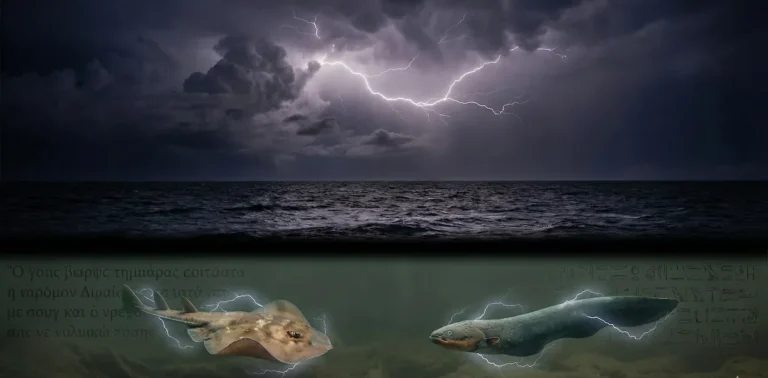
Lightning – Fire from the Sky
Awe, Fear, and Myth
If we could stand beside a shepherd in ancient Greece during a storm, we would see exactly what he saw:
A blinding flash. A shaking roar. A tree split open.
For him, there was no doubt who did it. Zeus had thrown a thunderbolt. In Rome it was Jupiter, in Norse lands Thor, in India Indra—almost every culture placed lightning in the hands of its chief god.
Lightning was not just weather. It was “judgment.”
A bolt that struck a temple, a field, or a person was read as a sign: blessing, warning, or punishment. Priests and diviners spent lifetimes interpreting these signs.
Aristotle’s Explanation: Burning Wind
Around the 4th century BCE, Aristotle tried to describe lightning without gods. His explanation shaped Western thought for nearly 2,000 years.
He imagined the world made of four elements—earth, water, air, fire. From the ground, two kinds of “exhalations” rose into the air:
Wet vapor – which formed clouds and rain
Dry, hot exhalation – which formed wind and sometimes fire
In his picture, lightning happened when dry, hot exhalations got trapped inside moist clouds. As the cloud squeezed and cooled, the trapped hot air suddenly burst out:
The violent burst created thunder
The friction of this hot air against the clouds made it ignite as fire—what we see as lightning
This view survived into countless medieval encyclopedias and commentaries. Authors updated the language, but the core idea stayed: hot, dry stuff trapped in clouds ignites and explodes. The theory was detailed, but it never came from experiments. It was built from analogy and logic, not measurement.
Lightning as a Message from God
As Christianity and Islam spread, the older storm gods changed names, but lightning kept its spiritual role.
In Christian Europe, lightning was often seen as an instrument of God’s will. Churches, monasteries, and cities struck by lightning were sometimes interpreted as under divine judgment or protection, depending on timing and context.
In the Qur’an, lightning and thunder are explicitly called signs of God’s power—things that should make humans reflect on their weakness and His strength.
St. Elmo’s Fire: Quiet Light on the Mast
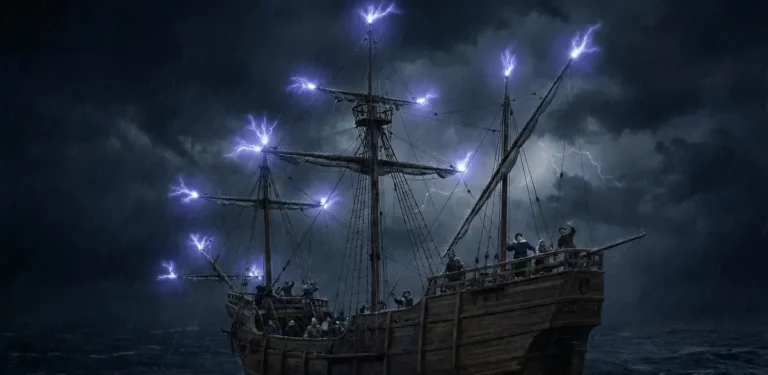
While lightning was the loud, violent face of storms, sailors knew a quieter cousin: St. Elmo’s fire.
During strong storms at sea, faint blue‑violet flames sometimes appeared on the tips of masts, yardarms, and even sailors’ spears. Today, we know this is a coronal discharge—air molecules glowing when a strong electric field pulls electrons off them.
To ancient and medieval sailors it was something else:
Greeks and Romans often called the lights Castor and Pollux or Helena, after protective deities of sailors.
Later Christian sailors renamed it St. Elmo’s fire, after St Erasmus, the patron saint of seafarers.
Seeing these flames during a storm was taken as a sign that the gods—or later, the saint—were present. Because St. Elmo’s fire often appears toward the end of the worst conditions, sailors naturally linked it with safety and survival.
Late Medieval and Renaissance Observations (1400s-1500s)
- People struck who were not burned, but left unconscious, paralyzed, or with one side of the body weakened.
- Survivors who described not just heat, but a violent shock and long‑lasting numbness or confusion.
Electric Fish – Thunder in the Water
While storms shook the sky, another kind of shock was quietly at work in rivers and seas.
Egypt: The “Thunderer of the Nile”
The story of electric fish begins in ancient Egypt, long before anyone wrote the word “electron.” In the Nile lived the electric catfish (Malapterurus electricus), a smooth fish capable of delivering powerful shocks—strong enough to stun a person or a predator.
The Egyptians knew this fish very well:
On the Narmer Palette (c. 3100 BCE), the first unifying pharaoh of Egypt took a name that combines the symbols for a catfish (Nar) and a chisel (Mer)—often interpreted as “the striking catfish” or “fierce catfish.” Power was symbolized not only by claws and teeth (like a crocodile) but by invisible striking force—a perfect metaphor for royal authority.
Tomb reliefs (type of sculpture where figures and designs are carved into the walls of a burial chamber), like those in the Mastaba of Ti at Saqqara (c. 2400 BCE), show fishermen carefully handling or avoiding the electric catfish in scenes of daily life.
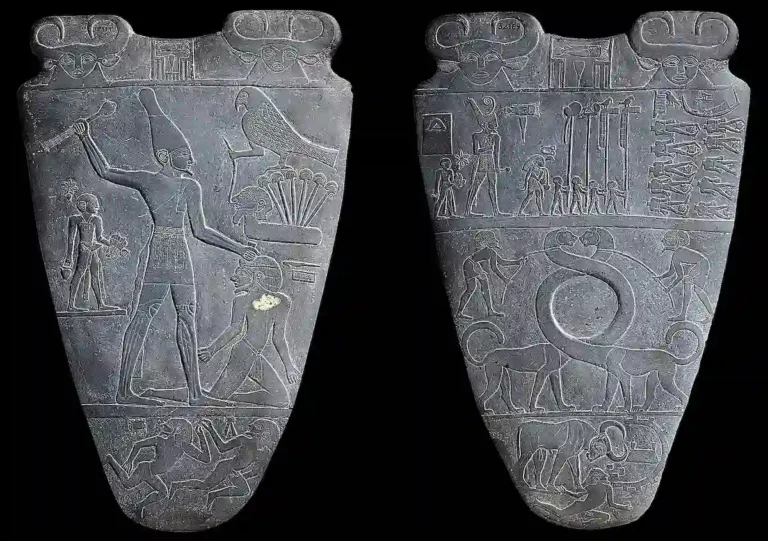
Later Arabic writers preserved its traditional name as “el ra‘ad” – “the Thunderer”, directly linking the fish’s numbing shock to the shaking sensation of thunder. This naming choice is important: while Greek and Roman writers separated fish and storm into different categories, Egyptian and Arabic language quietly hinted that there might be a connection.
Some medical texts suggest Egyptians used shocks from the fish to ease certain pains, particularly headaches—an early form of electrotherapy, even if they had no concept of nerves or electricity.
Greece and Rome: The Numbing Ray
In the Greek and Roman world, the star electric animal was not the catfish but the electric ray, especially the Mediterranean torpedo ray (Torpedo torpedo).
Aristotle (384–322 BCE) described the ray’s ability to stun prey and numb a fisherman’s arm. He emphasized that this was an active power in the fish—not just a bad taste or poison on the skin.
Theophrastus (c. 371–287 BCE) noticed something even more surprising: the shock could travel through a “bronze or iron spear shaft” to the fisherman’s hand. In other words, the fish’s power could be transmitted through a conductor, without direct skin contact.
This was a remarkable observation: an early glimpse of “conductivity.” A few authors later noted that the effect could spread through water around the fish too.
The most practical use came from Roman medicine:
Scribonius Largus (1st century CE), physician to Emperor Claudius, prescribed live electric rays for “gout and chronic headaches.” For gout (a painful form of inflammatory arthritis), the patient stood on a live torpedo at the seashore until the leg went numb. For headache, a fish was placed on the scalp until the pain subsided.
Later writers extended this to other conditions like a “prolapsed anus”, using the shock to trigger strong muscle contractions.
These treatments sound brutal, but they show a clear empirical insight: the fish’s invisible force can numb pain and affect muscles, long before anyone talked about nerve signals or electric currents.
Middle Ages: From Live Shock to “Occult Quality”
In the centuries after Rome, knowledge about electric fish followed two different paths.
In the Arabic World
Scholars such as Abd al‑Latif al‑Baghdadi (12th–13th century) continued to describe the Nile’s electric catfish and preserved the title “el ra‘ad – the Thunderer” for it. This naming kept alive the intuitive link between the fish’s shock and the shaking power of storms.
Some medical traditions in the region still used live fish for treatment, echoing Egyptian and Roman practices of electrotherapy.
In Medieval Europe
In Latin Europe, the torpedo ray became wrapped in the language of “occult qualities.”
Writers like Albertus Magnus (13th century) accepted that the fish produced numbness but placed this effect in a category of hidden powers that could not be explained by normal (Aristotle’s) hot/cold, wet/dry causes. Magnetism and the torpedo’s shock were the classic examples—real, but mysterious by definition.
Over time, the practical use of live fish faded. Instead, some medical texts recommended dried torpedo skin or preparations as talismans or remedies. Once the fish was dead and dried, its electric organ no longer worked. What remained was symbolism and belief, not actual electrical effect.
Renaissance Encounters and the New World (1500s)
The Renaissance revived interest in natural history. European scholars like Conrad Gesner and Ulisse Aldrovandi collected and published detailed drawings and descriptions of electric rays and other strange fishes.
At the same time, exploration of the Americas brought Europeans into contact with a third electric animal: the electric eel (Electrophorus electricus). Indigenous peoples already knew its power well and sometimes used it in healing or rituals.
These stories forced naturalists to admit: whatever this strange force was, it was not rare. It appeared in multiple species, in different parts of the world, with varying strengths.
Conclusion
Philosophers built separate theories for each, and those theories hardened over time. Only centuries later—after the “Leyden jar”, after controlled sparks, after careful dissections of electric organs—would scientists finally weave these stories together as different scales of the same electrical phenomenon.
FAQs
Did ancient doctors really prescribe electric fish as medicine?
Yes. In the 1st century CE, the Roman physician Scribonius Largus prescribed live electric rays for patients suffering from gout and chronic headaches. Patients would stand on a live fish on a wet beach until their leg went numb, using the bio-electric shock to block pain signals—essentially an ancient version of modern TENS therapy.
What is the "Thunderer of the Nile"?
This was the ancient name for the electric catfish (Malapterurus electricus) found in the Nile River. Ancient Egyptians and later Arabic scholars called it el ra’ad (“The Thunderer”) because they intuitively recognized that the shaking sensation of the fish’s shock felt exactly like the shaking vibration of thunder.
Which electric fish was known to the ancient world?
The ancient Mediterranean world primarily knew two: the Electric Catfish of the Nile and the Torpedo Ray of the sea. The most powerful of them all, the Electric Eel (Electrophorus electricus), was not known to European science until the exploration of the Americas in the 1500s.
Content Resources
Websites
Lightning: HGSS’s “Lightning and thunder explanations”
St. Elmo’s Fire: Wikipedia’s “St. Elmo’s Fire”
Ancient Electrotherapy: ACADEMIA’s “Ancient Egyptian Headaches: ichthyo – or electrotherapy?”
Wikipedia: “Electric Catfish”, “Narmer”, “History of bioelectricity”